Claude app · Designed & built · 2026
An AI reply composer that writes in my own voice
A Claude app that turns a pasted customer message and a one-line note into a send-ready reply for email, DMs, and comments, written in my voice from samples of emails I've actually sent.
The problem
Most of a support job is writing: order problems, returns, address mistakes, delivery questions. Templates sound like templates, and AI drafts usually read like they came out of a chatbot. Either way the customer can tell, and the reply needs rewriting before it’s worth sending.
What it does
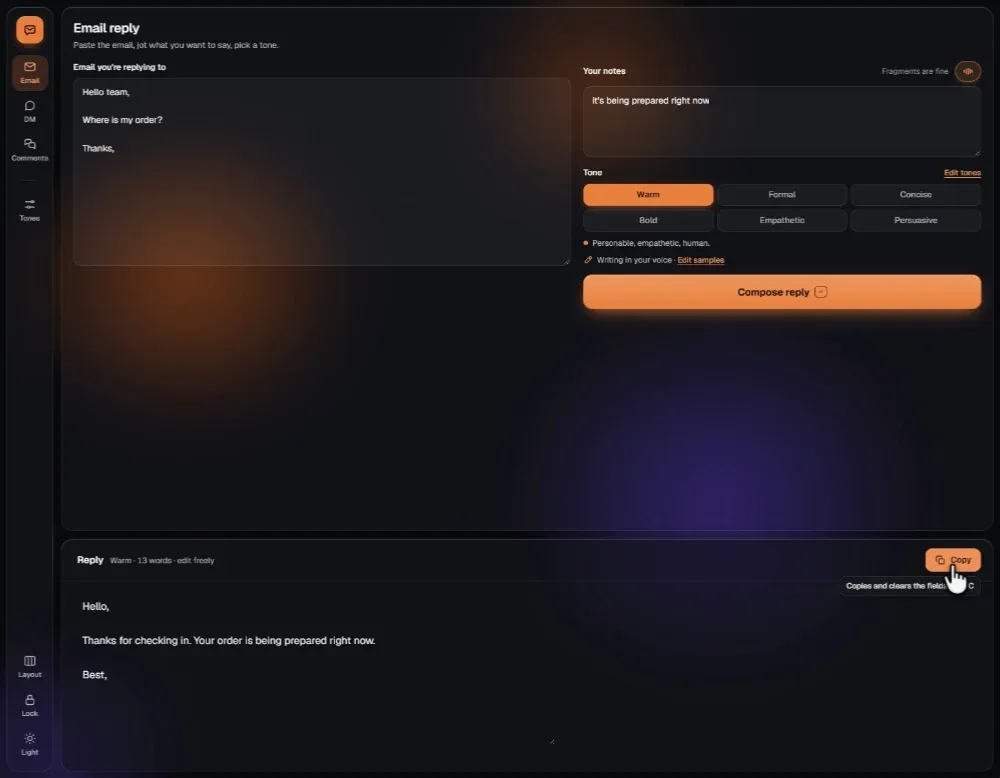
An incoming email is open. I paste it in, jot a one-line note like “we’ll need to create a new order, does that sound good to you?”, pick a tone, and get a send-ready reply in seconds. Then I copy it into the email client or social app and send.
It works in three modes, each with six tones I can edit:
- Email for replying to customer messages.
- Social DM for direct messages.
- Comments for public replies, which also takes the original post as context.
Written in my voice
The reply should read like something I’d have written myself on a good day, so the app learns from samples of emails I’ve actually sent. Every prompt also carries a layer that strips out machine-written habits before the draft reaches the screen.
My notes are the source of truth. The app keeps my facts and my wording, and it never invents a commitment I didn’t make, like a refund or a delivery date.
Built lean and private
- Low cost, low latency. It calls Claude Sonnet 5.5 at low effort, which is plenty for a short reply and keeps every draft fast and cheap.
- The API key never reaches the browser. Requests go through a small server-side proxy, so the key and the message content stay between my server and Anthropic.
- Not a general-purpose proxy. Prompts are built on the server from structured fields, so the endpoint can only write replies. Nobody can use it to run arbitrary Claude requests.
- Light and dark themes, with animation kept light so it never costs speed.
Why I built it
It’s the way I already try to write, turned into a tool: lead with what’s been done, name the specific detail, close with a real question. The difference is that now it holds on every reply, even at the end of a long shift.